/ Guide · AI search
How to Get Your Business Found on ChatGPT, Claude, Perplexity and Google AI Overviews (2026)
For years, the goal was to be found. Now, the goal is to be recommended.
Rachit Hegde · Co-founder & Digital Marketing Head
Last updated: July 2026
Hi, I'm Rachit, co-founder and digital marketing head at The Small Business Project.
A good chunk of the inquiries we get these days are from businesses asking us to help them “rank on ChatGPT” or “show up on AI search.” We turn most of them down. Not because we can't help, but because most people come to us wanting it done in two weeks. That's simply not how this works.
This guide is the version of the conversation we'd normally have on a call: what AI visibility actually is, why it takes the time it takes, and what a business genuinely needs to do about it. No jargon, I promise.
/ On this page▾
The short answer
/ Key takeaway
People used to type a question into Google and click through a list of blue links. Increasingly, they're asking ChatGPT, Perplexity, or Gemini directly, and getting a written answer that already names a business, a product, or a service, with no clicking required.
Google itself now does this too, its AI Overview sits right at the top of search results and answers the question before a single website link appears.
Getting mentioned inside those answers is what we mean by AI visibility. Some people call this GEO (Generative Engine Optimisation) or AEO (Answer Engine Optimisation), we just call it AI visibility, because that's what it actually is.
It isn't a switch you flip. It's a combination of making your business easy for AI tools to read and understand, making sure what they find is accurate and consistent everywhere, and giving them genuine reasons, real information, real reviews, real proof, to mention you over someone else.
Businesses that treat it as a quick fix are usually the ones who never see it work. Businesses that treat it as an ongoing practice, the way they'd treat maintaining their reputation, are the ones who start showing up.
Why I'm actually excited about this, and a bit of history first
In my last nine years running The Small Business Project, the most enquired service, by far, was SEO. Maybe because it's the loosest word in the room whenever people talk about growing a business or getting discovered online.
Here's the thing though, I'd turn most of those enquiries down. Not because we couldn't do it, but because I'd rather be honest upfront: no search engine gives you real results overnight, or even in a couple of months.
You need patience, realistically six months to a year, sometimes two. Once I said that out loud, most people quietly disappeared. The ones who actually stuck around and passed that check were a small fraction of everyone who first reached out.
Everyone else, I'd point toward our actual hero service, performance marketing and running ads, because if you need results now, that's genuinely the honest answer, not SEO dressed up to sound faster than it is.
The patience problem
In a market this competitive, everyone's tempted by immediate results. Very few founders or leadership teams actually sit with the idea of long-term compounding returns long enough to invest in it properly.
But the businesses that did, the ones who stuck with SEO patiently over the years, have organic returns today that the impatient ones simply don't. SEO was never for everyone.
- Some businesses need results today. Their customers have high purchase intent and are ready to act now.
- Others are in an education phase. Their customers slowly discover the brand because the brand actually informs them first, without constantly trying to sell.
Being informative, precise, and useful, without disguising it as a sales pitch, is what “education-first” actually means here.
From gaming to earning
Now bring AI platforms into this picture, ChatGPT, Claude, Perplexity, and it gets more interesting, not less. We're moving past a phase of manipulating search engines with keywords, toward something closer to a genuine digital footprint.
Or, to put it more simply: this is a shift from gaming the system to earning it, not gaming it.
/ The window is still open
Yes, some people are already rushing to game AI citations. But those tactics haven't caught up yet. There's a real window where actual substance has the advantage, and it won't stay open forever.
Businesses moving on this early, with real information instead of tricks, get a head start that's genuinely hard to copy later.
Personalised answers change how you check visibility
Another real difference: answers increasingly get tailored to the person asking. Their location, their situation, what they've already told the tool.
Two people asking an AI tool the exact same question, from different cities or with different context, can get different answers. So you can't just check your visibility once and assume that's the whole picture. It's worth checking from a few different angles over time, not a single test.
“AI visibility is like being recommended by someone who's never met you, based only on what's written about you online. No conversation, no chance to make your case in person, just your public footprint speaking for you. So that footprint needs to be consistent and credible everywhere it appears.”
AI visibility works the same way. There's no trick that gets you there faster, at least not yet. You earn it by actually being worth recommending, and then the recommendation follows.
Before AI, and after AI
The easiest way to understand what's changed is to compare how someone finds a business today versus five years ago.
| Before AI search | After AI search | |
|---|---|---|
| How people search | Type keywords into Google, scan a list of links | Ask a direct question in plain language to ChatGPT, Claude, Perplexity, Gemini, or Google's AI Overview |
| What they see first | Ten blue links, ranked by Google | One written answer, already naming a few businesses |
| How a business gets found | Rank high enough to get clicked | Get mentioned or quoted inside the answer itself |
| What mattered most | Keywords, backlinks, technical SEO | All of that, plus being written about clearly, consistently, and by others, not just yourself |
| The website's job | Convince a visitor who already clicked | Convince a machine to mention you before anyone clicks at all |
| Where trust comes from | Your own site content and Google's ranking signals | Your site, plus every other place your business is mentioned: reviews, directories, articles, forums |
“Being listed gets you seen. Being recommended gets you chosen.”
The core shift is this: Google used to send people to your website to make up their own mind. AI tools increasingly make up the mind for them, and your website is just one of several sources it reads before answering. That changes what “being findable” actually requires.
Why this matters now, not eventually
This isn't a future trend, it's already changing how people make decisions.
/ The common misbelief
“Let's just add some keywords and write a few blog posts, that'll get us traffic.”
If it were genuinely that simple, this space wouldn't be anywhere near as competitive as it is.
The truth is blunter: adding keywords tells a machine what your page is about. It does nothing to convince that machine your page is worth mentioning over someone else's.
Those are two completely different jobs, and most businesses only ever do the first one.
The search landscape has already shifted
Searching through AI and LLM-based tools is here to stay. This isn't a phase.
Gartner predicted that traditional search volume would drop 25% by 2026 because of AI chatbots. The more precise picture that's emerged since is even more telling:
- Total search hasn't actually shrunk.
- Google's share of information discovery fell from around 89% to under 58% in under three years.
- AI tools captured almost all of the new growth in how people search.
In plain terms: people aren't searching less. They're increasingly searching somewhere else first, and your business needs to exist there too.
/ The shift, in numbers
89% → 58%
Google's share of information discovery, in under three years.
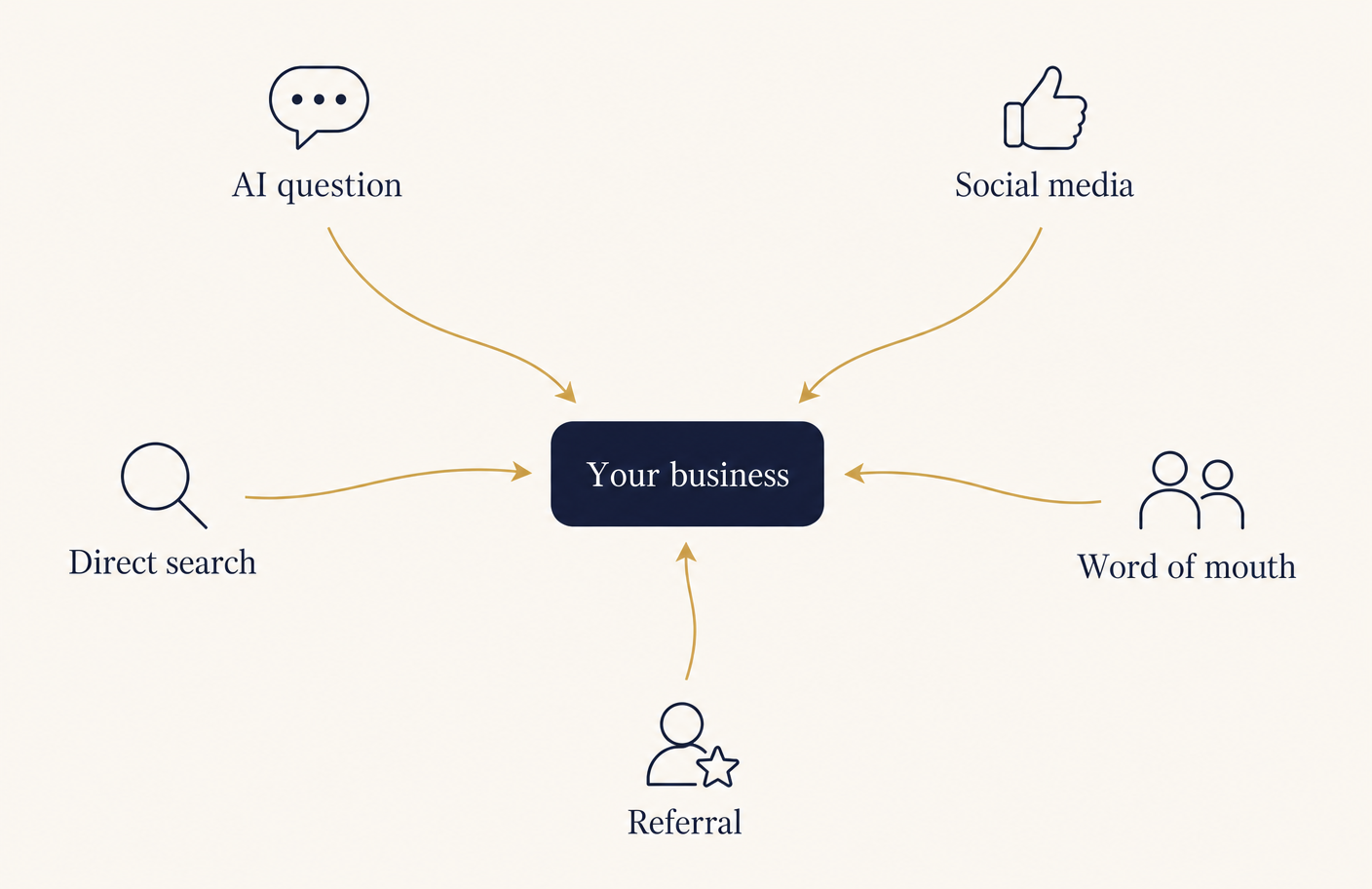
The funnel is no longer one straight line
People now enter their buying journey from wildly different starting points:
- Some already carry information AI tools fed them earlier.
- Some found you on social media first and are now checking whether you're legitimate.
- Some typed a direct search the old-fashioned way.
- Some simply heard your name somewhere and want to know if it's real.
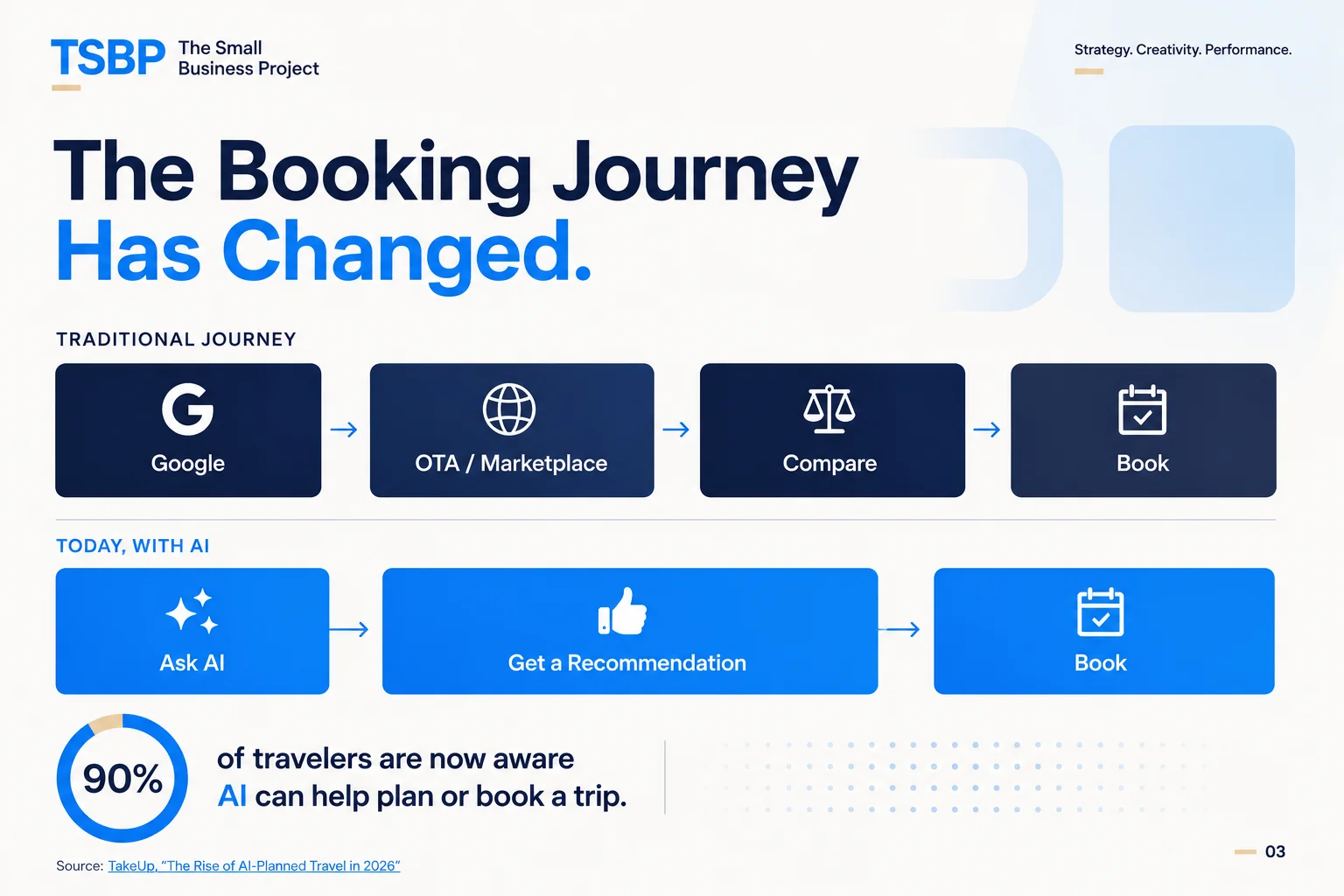
The old, single funnel, search, click, compare, buy, doesn't hold the same way anymore.
The uncomfortable truth
If an AI tool doesn't know you exist, or knows you inaccurately, you don't get a chance to make your case.
Nobody clicks past an AI answer to check ten other options the way they used to scroll a search page. The AI's answer often is the shortlist.
The same shift applies to any business with high exposure to marketplaces and aggregators, whether e-commerce, hotels, or resorts. AI visibility now shapes these decisions just as much as it does for direct bookings.
How AI tools actually decide who to mention
This part surprises most people. Understanding it explains everything about what actually needs to be done.
Two things happen behind the scenes
When someone asks an AI tool a question like “best marketing agency for a small business,” two things happen:
- Find the candidates. The AI searches the web, much like Google would, and looks at a batch of results. If your business isn't findable there at all, it's never considered, full stop.
- Choose who to trust. The AI reads through those results and decides which ones to mention. It tends to favour:
- Pages that answer questions directly and clearly.
- Businesses that publish specific facts and real numbers, not vague claims.
- Content written by an identifiable person, not anonymous copy.
- Businesses described consistently and accurately across many different places, not just their own website.
/ The detail most businesses miss
If your website says one thing, your Google listing says something slightly different, and a directory profile has outdated information, AI tools notice the mismatch and tend to hedge or simply leave you out.
Consistency matters more than most people expect.
Each platform reads things differently
It's also worth knowing that the major platforms don't all work identically.
Google AI Overview
Leans heavily on Google's own traditional ranking signals, so classic SEO fundamentals still matter most.
Perplexity
Draws unusually heavily on Reddit and community discussion as a source.
ChatGPT
Search leans on Bing's index behind the scenes, so being properly indexed in Bing (not just Google) matters more than most businesses realise.
Claude
Draws on a mix of sources like the others, and increasingly favours content that reads as clear and specific over content that reads as promotional.
Different platforms, different plumbing, same underlying principle: be findable, be accurate, be consistent.
“Stop trying to rank. Start trying to be the answer.”
What a business actually needs to do
Strip away the jargon and it comes down to four honest habits, not a one-time project.
Make your website easy for machines to read, not just humans.
A lot of modern websites hide their real content behind animations, sliders, or JavaScript that loads after the page appears. Humans see it fine. The tools reading your site for AI purposes often don't. The current version of your site needs to say what it needs to say in plain, readable text, immediately.
Say the same true things everywhere.
Your website, your Google Business listing, your LinkedIn, any directory you're listed on, they all need to agree on the basics: what you do, since when, where, and any numbers you're proud of. Contradictions between these sources quietly undermine trust with AI tools, even when each individual page looks fine on its own.
Publish real, specific, useful information, not marketing language.
Vague claims like “industry-leading service” get skipped. A specific number, a real range, a genuine explanation of how something works, or an honest answer to a question a customer would actually type, gets noticed and gets cited. This is the part that takes real time and real expertise to do well, and it's usually the part rushed requests skip entirely.
Earn mentions outside your own website.
Reviews on trusted, verified platforms, mentions in articles, listings in directories relevant to your industry, these matter as much as your own site does, sometimes more. AI tools cross-check what others say about you, not just what you say about yourself.
What to actually expect, timeline-wise
This is the part we're the most honest about, because it's also the part that gets us the most pushback. It helps to think of it in stages rather than one single date.
- 01Weeks 1–4
Technical foundations
Making your website readable to machines, fixing inconsistencies, getting properly indexed, can usually be done properly in a couple of weeks, and search engines and AI tools tend to notice within two to four weeks after that, especially if you actively ask them to recrawl rather than waiting.
- 02Months 1–2
First signals
The first real signs of AI tools mentioning you tend to show up next, often within one to two months, but usually only for specific, less competitive questions: things like “what does this cost” or “who runs this company,” where there's less competition and clear, specific answers stand out easily.
- 03Months 3–6
Broader competitive terms
Broader, more competitive questions, the “who's the best” kind, take considerably longer, typically three to six months, because they depend on more than your own website. They pull heavily from reviews, directories, and other people mentioning you, and that kind of third-party presence simply takes months to build properly. There's no shortcut here, and anyone who tells you otherwise is skipping this part on purpose.
- 04Months 6–12+
Steady presence
Meaningful, steady presence across the board usually takes six to twelve months of consistent effort, and even then it isn't a finish line. AI tools keep re-reading and re-evaluating information over time, so staying visible means staying active, not completing a project once.
If someone tells you this can be done in two weeks with guaranteed results, be skeptical.
We turn down a fair number of inquiries for exactly this reason: people come to us wanting the outcome without the runway it genuinely needs. Setting that expectation honestly upfront saves everyone a bad experience later.
What this looked like on our own website
/ What we found on our own site
We didn't write this guide from theory, we did it to ourselves first.
When we checked what our own homepage said in its raw, machine-readable text, it read “0+ businesses scaled, $0M+ ad spend managed.”
The real numbers, 210+ and counting, were sitting right there for any human visitor, animated onto the screen. But animations don't exist for a machine reading the page's underlying code. It was reading zeros.
Any AI tool checking our own facts would have had every reason to doubt us before we'd said a word.
We also found a Clutch profile for our own company that had existed for a while without anyone at TSBP ever logging into it. A genuinely common situation, these profiles often get created automatically and just sit there unclaimed and unused.
Neither of these was a dramatic failure. They were exactly the kind of small, invisible gaps that quietly cost a business its credibility with AI tools.
The sort of thing a business only finds by actually going and checking, not by assuming everything's fine because the website looks fine to a human.
Getting started: a simple starting checklist
You don't need an agency to begin. Any business can do this much on their own:
Step 01
Check what your website actually says in its raw text, not what it looks like. If the important facts (what you do, since when, key numbers) aren't there in plain readable text, that's the first fix.
Step 02
Go through every place your business is listed online, your website, Google Business Profile, LinkedIn, any directories, and make sure they all say the same true things.
Step 03
Ask an AI tool directly what it knows about your business. If it gets something wrong or has nothing to say, that's your starting point.
Step 04
Start asking for and collecting genuine reviews on platforms that verify them. This is slower to build than most people expect, and worth starting today rather than later.
FAQ
How is this different from regular SEO?+
Regular SEO is mostly about ranking high enough in search results to get clicked. AI visibility is about being accurately read, understood, and mentioned by an AI tool that's composing an answer on someone's behalf, often without any click happening at all. The foundations overlap, but the goal is different: convincing a machine to vouch for you, not just convincing Google to rank you.
Can I do this myself, or do I need an agency?+
The basics, readable website content, consistent facts across platforms, collecting reviews, any business can start alone. Where it gets harder is producing the kind of specific, genuinely useful content that AI tools favour, and consistently maintaining accuracy across many platforms over time. That's usually where outside help earns its cost.
How do I know if it's working?+
Ask AI tools directly, periodically, the kinds of questions a customer might ask, and see if your business gets mentioned, and mentioned accurately. Track this over months, not days; a single check tells you very little.
Is this a one-time fix?+
No, and anyone promising that isn't being fully honest with you. AI tools continuously re-read and re-evaluate information. Staying visible means staying accurate and current, not completing a project once.
Why do you turn down some AI visibility inquiries?+
Because the honest version of this work takes real weeks and months, and we'd rather say no upfront than take on a project we can't deliver on the timeline someone's expecting. If a business isn't ready for that pace, it's a bad fit for both sides.
More guides
- What Performance Marketing Actually Costs in India (2026)
- Agency vs In-House vs Freelancer: Who Should Run Your Paid Ads? (2026)
- Meta vs. Google Ads for E-commerce: Which Wins Your Budget?
The Small Business Project has spent nine years in performance marketing and has been building its own AI visibility in the open, starting with our own website. If you want an honest read on where your business currently stands, start with an audit: you'll get a straight answer either way.